Mechanical Timers — No Batteries, No Screens, Pure Focus
Mechanical timers are the original productivity tool. Before apps, before smartphones, before digital displays — there was the wind-up timer. No batteries to replace. No charging cables to forget. No software updates. Just a precision spring mechanism that counts down reliably, ticks satisfyingly, and rings clearly when your time is up.
Why Mechanical Timers Endure
In an increasingly digital world, mechanical timers represent a deliberate choice to disconnect and focus. The act of physically winding a mechanical timer to your desired interval is itself a focusing ritual — a tactile commitment to the session ahead. There's nothing passive about it.
Mechanical timers also tick. This continuous, gentle ticking creates a subtle auditory awareness of time passing. Many users find this ticking helpful — it keeps them anchored to the present moment and aware that time is moving. Others prefer silent timers; the choice is personal and worth considering.
The Pomodoro Connection
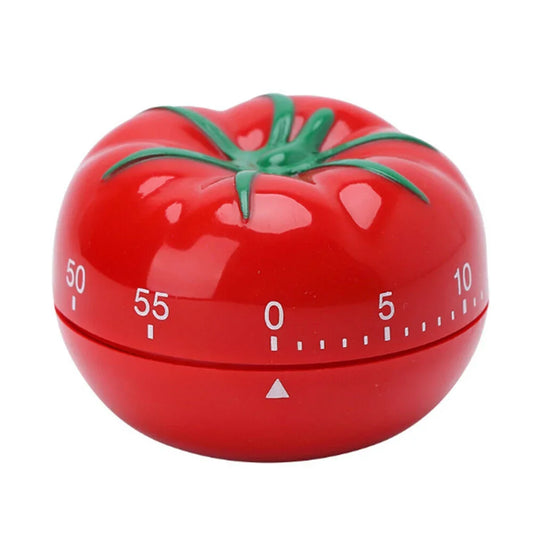
Francesco Cirillo, who developed the Pomodoro Technique in the 1980s, named his productivity method after the tomato-shaped mechanical kitchen timer he used as a university student. The Italian word for tomato — pomodoro — became the name for both the timer tool and the 25-minute focus intervals it measured.
To use the authentic Pomodoro method as its creator intended, a mechanical timer is the appropriate tool. Wind it to 25 minutes, work without distraction until it rings, then take a 5-minute break. The original, unchanged — and still highly effective.
Types of Mechanical Timers
Tomato-shaped timers: The classic, iconic Pomodoro tool. Fully mechanical, 60-minute capacity, bell alarm. Available in red (classic), green, orange, and other colours. Widely used in home kitchens and home offices.
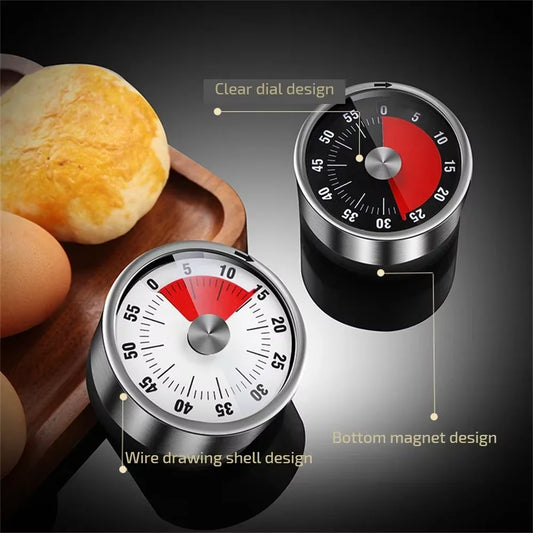
Cylindrical mechanical timers: Traditional kitchen timer shape with a rotating dial and mechanical mechanism. Often includes both a count-down timer and a clock face. Magnet on base for fridge mounting.
Dial timers: Large rotating dials that wind to up to 60 minutes. Easy to read remaining time at a glance as the dial shows the set angle.
Mechanical Timer Advantages
-
Zero operating cost — no batteries, no electricity, no subscriptions
-
Unlimited lifespan — quality mechanical timers last decades with minimal maintenance
-
Instant startup — no boot time, no pairing, no settings to configure
-
No digital distractions — using a mechanical timer keeps your phone in your pocket where it belongs
-
Works anywhere — no power outlet, no Bluetooth, no Wi-Fi required
-
Tactile satisfaction — the physical wind-and-release action is genuinely satisfying
-
Beautiful design — classic mechanical timers are attractive objects worth displaying
Mechanical vs Digital: Which Is Right for You?
| Feature |
Mechanical |
Digital |
| Battery required |
No |
Yes |
| Accuracy |
Within 30-60 seconds/hour |
Within 1-2 seconds/day |
| Ticking sound |
Yes |
No (usually) |
| Visual progress |
Dial position |
Numeric display |
| Maximum time |
60-90 minutes typically |
Up to 99 hours |
| Lifespan |
Decades |
3-10 years |
| Aesthetic |
Classic, artisanal |
Modern, minimalist |
Caring for Your Mechanical Timer
Quality mechanical timers are very durable but benefit from basic care:
- Don't over-wind — stop at your desired time, not beyond maximum
- Allow to run down before winding again (avoid reverse-winding)
- Keep away from water — mechanical mechanisms aren't waterproof
- Store upright or flat — avoid storing on their side for extended periods
- Clean with a dry cloth — avoid chemical cleaners on the mechanism
Frequently Asked Questions
- How accurate are mechanical timers?
- Mechanical timers are accurate within 30-60 seconds per hour. For productivity use, this is perfectly adequate. For second-precise scientific work, choose a digital timer.
- Do mechanical timers tick?
- Yes — mechanical timers tick as part of their mechanism. Many users find this helpful for time awareness; others prefer silent digital timers. Consider your environment and preference.
- How long do mechanical timers last?
- Quality mechanical timers can last 10-30 years or more with normal use. The spring mechanism is remarkably durable.
- Can a mechanical timer be used for the Pomodoro Technique?
- Yes — in fact, the Pomodoro Technique was invented using a mechanical kitchen timer. A 60-minute mechanical timer is the authentic tool for Pomodoro practice.
- Are mechanical timers loud?
- The alarm bell on mechanical timers is generally loud — 70-80dB or more. This makes them ideal for noisy environments but potentially disruptive in quiet offices. The ticking is quiet and unlikely to disturb others.