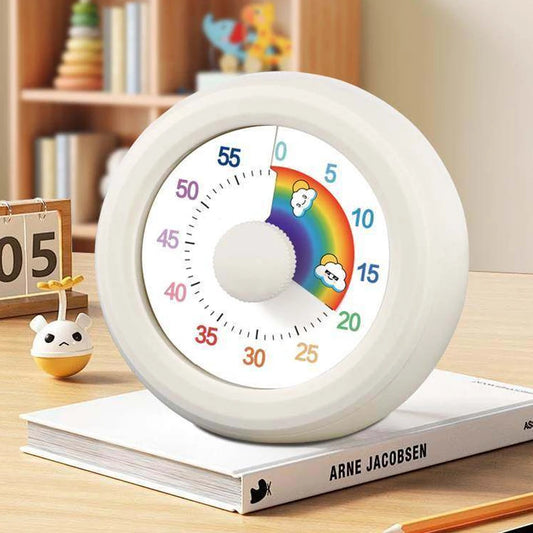
ADHD Timers — Tools That Work with Your Brain, Not Against It
Time blindness is one of the most challenging aspects of ADHD. Without a visible, concrete representation of time passing, minutes and hours blur together — making deadlines feel sudden and tasks feel never-ending. ADHD timers address this directly by making time visible, tangible, and non-threatening.
Understanding Time Blindness in ADHD
People with ADHD typically experience two time states: "now" and "not now." There's little middle ground — no graduated sense of time approaching or passing. This isn't laziness or poor planning. It's a neurological difference in how the ADHD brain processes temporal information.
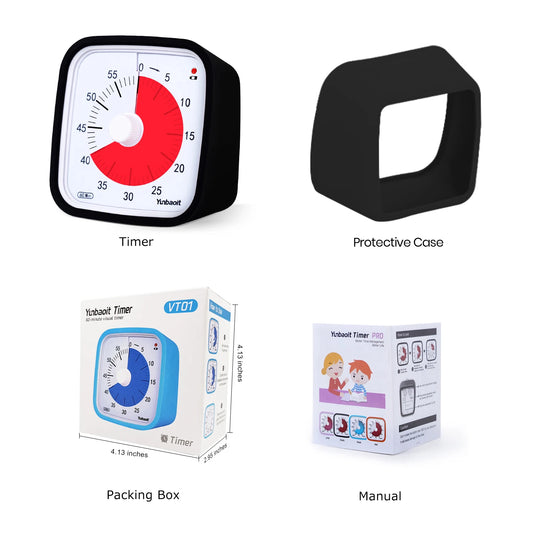
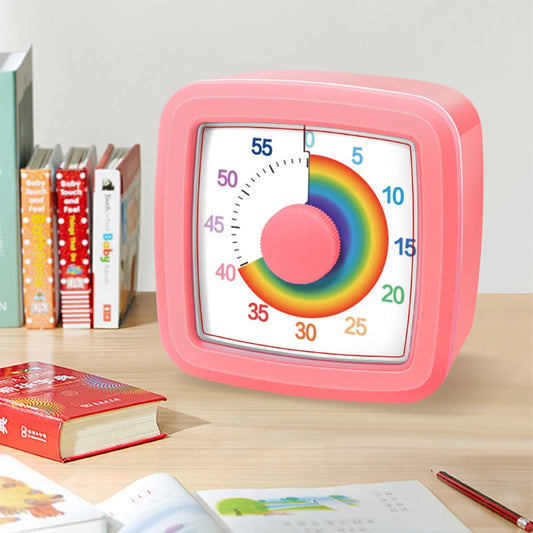
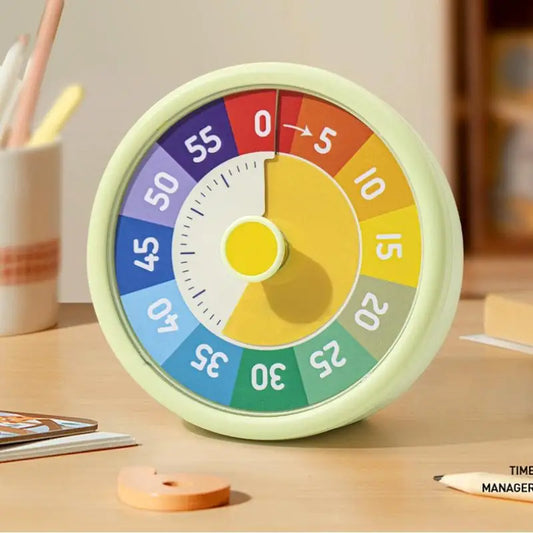
Traditional clocks and digital countdowns don't help much — seeing "14:32" tells you the time but doesn't tell your brain how much time has elapsed or how much remains in a useful, felt sense. A visual timer changes this by presenting time as a spatial concept: a shrinking colour arc, disappearing LED segments, or a rotating disc. The brain processes spatial information far more efficiently than abstract numerical time.
Why Visual Timers Are Recommended for ADHD
Occupational therapists, ADHD coaches, and educational psychologists consistently recommend visual timers as one of the most effective accommodations for time blindness. The benefits include:
-
Immediate time awareness — glancing at a visual timer gives instant understanding of remaining time without calculation
-
Reduced transition anxiety — seeing time remaining before an activity ends allows mental preparation for what comes next
-
Hyperfocus interruption — the alarm breaks hyperfocus episodes at appropriate intervals
-
Task initiation support — setting the timer creates a clear start signal, addressing one of ADHD's most common challenges
-
Reduced overwhelm — breaking tasks into timed segments makes them feel manageable rather than endless
-
External accountability — the timer holds you accountable in a non-judgmental, mechanical way
ADHD Timer Strategies for Adults
Body doubling with timers: Work alongside someone (in person or virtually via video call) while using a timer to structure sessions. The combination of social presence and time structure is particularly effective for ADHD.
The 10-minute start: If task initiation is difficult, set the timer for just 10 minutes and commit only to that. The low stakes of a short session reduce the psychological resistance to starting. After 10 minutes, most adults with ADHD find they want to continue.
Transition warnings: Set the timer 5-10 minutes before an important transition (dinner time, school pickup, meeting). The visual countdown provides the advance warning ADHD brains need to shift gears smoothly.
Task batching: Group similar small tasks (emails, phone calls, filing) into one 25-minute block. The timer creates urgency that prevents small tasks from expanding to fill unlimited time.
ADHD Timers for Children
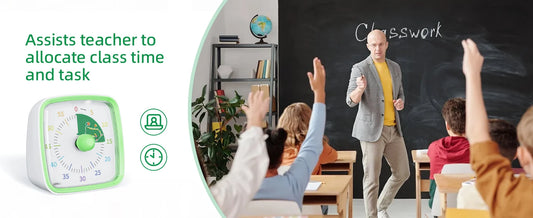
Children with ADHD benefit enormously from visual timers at home and school. Key use cases include:
- Homework time — clear start and end with a visible countdown prevents homework from feeling endless
- Screen time limits — the child can see their remaining screen time without parent reminders
- Morning routines — getting ready before school with timed segments for each step
- Bedtime transitions — wind-down timer makes bedtime less abrupt and confrontational
- Chore management — timed chore sessions with clear endpoints feel fair and manageable
- Meltdown prevention — visual timers reduce anxiety during activity transitions
What to Look for in an ADHD Timer
-
Large, clear visual display — immediately obvious how much time remains
-
Colour-coded arc or segments — use visual/spatial rather than numeric time representation
-
Silent countdown option — ticking can be distracting or anxiety-inducing for some ADHD brains
-
Simple operation — one knob or one flip; complex interfaces create friction
-
Adjustable alarm volume — quieter for home use, louder for noisy environments
-
Durable build — for children especially, timers need to withstand drops and rough handling
Recommended Timer Settings for ADHD
Start with shorter intervals than you think you need. If 25 minutes feels overwhelming, begin with 10-15 minute Pomodoros. As your focus tolerance builds (and it will, with consistent practice), gradually extend sessions. The goal is to find an interval that feels challenging but achievable — not one that feels punishing.
Flowtime Technique for ADHD
The Flowtime Technique (also called Flowmodoro) is gaining popularity among adults with ADHD who find that 25-minute Pomodoro intervals interrupt valuable hyperfocus sessions. With Flowtime, you work until focus naturally fades, then rest proportionally. Use a visual timer as a gentle check-in rather than a forced stop — if you're still deeply focused when it sounds, simply note it and continue. This respects ADHD hyperfocus while still providing the external time awareness that ADHD brains need.
Frequently Asked Questions
- What is the best timer for ADHD adults?
- A large-face visual timer with a colour arc display is widely recommended. Rechargeable models are convenient; silent countdown is important for focus environments.
- Do visual timers help with ADHD?
- Yes — visual timers are one of the most-recommended, evidence-backed tools for managing ADHD time blindness. They make abstract time concrete and visible.
- What size Pomodoro should I use for ADHD?
- Start with 10-15 minutes if 25 feels too long. Gradually work up to 25 minutes. Some ADHD adults do well with 50-minute sessions once focus is trained.
- Can ADHD timers help with homework?
- Absolutely — structured homework sessions with visible countdowns significantly reduce resistance and improve completion rates in children and adults with ADHD.
- Are cube timers good for ADHD?
- Cube timers can work well for ADHD adults who respond to the flip ritual as a focus trigger. For children or those who need visual progress tracking, a colour-arc visual timer is usually more effective.